Kye Richardson leaves work at around 6pm. As usual, he’s stayed a few hours late to plan classes and finish marking for the next day. As he walks up to his car in the staff carpark of the school, he sees his headlights have been smashed by a student. He sighs. It’s one more reason on his long list of why teaching is just not worth it anymore.
The Australian Education Union (AEU) and the Victorian Government has reached an agreement that could see teachers and education support staff receive up to a 32% pay rise over the next four years.
The proposed agreement falls just short of the AEU’s initial ask of a 35% raise, but teachers say pay isn’t enough to fix the problems facing public schools.
High workloads, poor student behaviour, chronic understaffingand increasing pressure are making education an unsustainable profession.
The agreement follows months of negotiation and industrial action taken by teachers across the state, including the first statewide teachers strike in 13 years.

Beechworth local, Kye Richardson, 28, always felt like he was going to become a teacher.
“You go into the industry because you love to see them shine. You love to see their big moments,” he said.
He taught for just five years before leaving the profession. When asked if he would go back for a salary increase of up to $15,000 per year, his answer was blunt.
“F*** no. Not if I can help it”
Kye’s time as a teacher in a local public secondary school was shaped by crippling workloads, low pay, a lack of respect, limited support and violent student behaviour.
“it’s hard to think back to one particular moment why teaching is hard because there’s so many layers to it. I was always thinking about my work. I could never go home and not think about it.”
Problems go beyond pay
The damage to Richardson’s car was just one of many violent incidents he witnessed at school. He describes feeling horror and helplessness as watched students physically assault each other. In another particularly confronting incident, he said that when a staff member entered an elevator,
“Students followed and beat the living daylights out of him.”
A recent study found that violence in Australian schools has increased by 78% since 2011. In 2025 alone, 2886 injury claims were made to WorkSafe Victoria from education staff. Education is also one of the top industries for mental injury claims.
For Richardson, it made teaching “not worth it.”
“I would come home and just feel dead,” he said. “I didn’t want to be touched. I didn’t want to talk. I wanted to disassociate.”
Despite the impact on his own mental health, he recognises that these incidents are symptomatic of bigger challenges students are facing outside the classroom.
“The conditions of which they grow up in is not their fault,” he said.
“Some of these young people did not have any of their basic needs met… There is not the systems in place that help you succeed because the challenges have become exponential.”
Violent and disrespectful student behaviour is only one part of the problem. Teachers are expected to complete piles of administrative work for curriculum development, reporting requirements, marking and classroom documentation in just a few hours each week.
Data shows that the average Australian teacher is working 50 hours per week, and that teachers are contributing $11.5 billion in unpaid labour every year.
Richardson was doing a “a full day of work for no pay” every week to try and give his students as many opportunities as possible but still felt like he was having to “constantly compromise on something.”
“Do I compromise on my lessons so I can make sure that this behaviour is followed up appropriately? Do I compromise on the opportunities I want to give my young people because I want to make sure the quality of my lessons are really good? Do I compromise on the resources that I get?”
The result of experiences like Richardson’s is chronic understaffing in public schools. It’s a problem that’s likely to worsen.
76% of teachers intend to stop working in public schools over the next four years. The most commonly cited reasons for leaving include high workloads, low salary, a lack of respect and poor student behaviour.
The Victorian Government Schools Agreement
The in-principle Victorian Government schools agreement aims to improve working conditions for teachers and education support staff. Alongside salary increases, it includes additional planning days, protections around work hours, and increased consultation with staff.
In an AEU press release, Victorian branch President Justin Mullaly said it’s “a win” for teachers.
“Nationally competitive pay and measures to tackle overwork and burnout will help keep experienced educators in the sector and attract the next generation,” he said.
It’s not enough for public schools
Education policy expert Glenn Savage says the terms of the agreement are “important signals that governments value the profession,” but that they’re unlikely to fix the structural issues making education and staff retention so difficult.
Victorian public schools are the lowest funded in the nation but educate the majority of students from disadvantaged and low-socioeconomic backgrounds. This means teachers are often left to help students overcome complex social needs and structural inequalities.
“Teachers in disadvantaged schools often spend large amounts of time managing issues associated with poverty, housing instability, mental health and disengagement. Schools cannot solve those challenges alone,” Savage said.
Teachers want to stay
Lynette Campbell, 61, is a teacher and Arts leader at Wodonga Senior Secondary College who deals with those challenges every day. She’s been teaching for more than 20 years, and has watched the pressures placed on teachers increase.
“We go into teaching, because we love it, we love education, we love learning,” she said.
“But we find ourselves more a social worker than an educator, and that’s straining.”
Campbell is an AEU member, and took part in the strikes and industrial action earlier this year. Campbell holds hope that salary increases will attract new teachers to the profession and help keep both teachers and education support staff at schools longer.
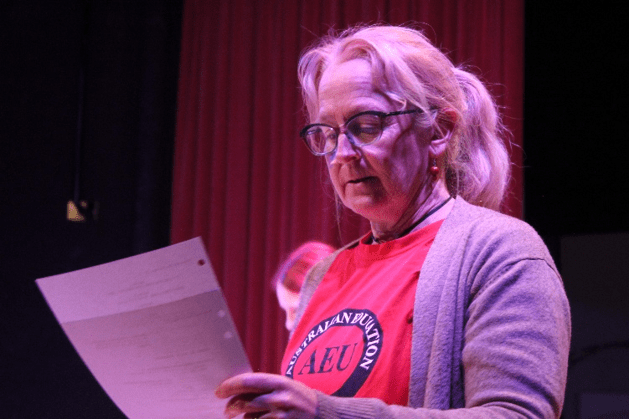
It’s something that she believes is critical to turning around the education experience for both students and teachers alike.
“The only way to teach our students is to build a relationship with them so that they trust you… Once you get their trust, then you can get their engagement and then they can start learning. But if they’re getting a different teacher in front of them every 6 to 12 weeks, then they’re never gonna trust those teachers, and they never start that engagement process,” Campbell said.
While she thinks an improved salary will help, she says it will not overcome all the challenges that are driving passionate teachers away. She says that teachers face “awful pressure” and expectations that make the job “really not possible.”
“We need more funding… more support… more recognition and more respect.”
Campbell loves being a teacher, but admits that the worsening conditions over the past few years have made her consider leaving.

“Teaching is wonderful when you see the kids succeed. But now I feel like I’m not getting anywhere… I mean, I have year 11s who can’t write,” she said.
“When you see them leaving, dropping out, then you blame yourself, what have I done wrong? Then you start to want to leave because you feel like you’re a failure.”
“But the kids have been failed by the system since they walked into prep.”


Leave a comment